

This post may contain affiliate links. Please read my disclosure for more information.
Hike, Sight, and Slice
 Where: Portland, OR
The hike: The Wildwood Trail in Portland’s Forest Park
The sight: The Witch’s Castle and Mount Hood
The slice: Lovely’s Fifty Fifty
Neither Clarissa or I had ever been to the Pacific Northwest, despite plenty of people telling us that we’d love it. So, last year, when she saw that my favorite musician would be playing in Portland in April 2026, she figured this would make a great Christmas gift. She bought concert tickets, arranged airfare, and booked a hotel room—all I had to do was wait.
This explains why we ended up in Portland earlier this month, which also gave me an opportunity to explore a new series I’ve been thinking about for awhile; Hike, Slice, and Sight. The setup is simple. I love hiking, pizza, and seeing cool things. When I have the opportunity to travel, I’ll take advantage of the situation and enjoy a cool trail, an awesome local pizza, and an amazing sight, whether it’s a scenic view or a point of interest. These aren’t travel guides or food blogs, at least not in the strictest sense, and I’m not reverting to writing trail guides. Instead, think of these as me learning about, and sharing, a little bit of local color. The details in Hike, Sight, and Slice are cultural; this series is an exploration of the spirit of a place.

Visiting Portland
Portland is a great place to kick off Hike, Sight, and Slice, because not only is it a city known for great food, but it also has some excellent urban hiking trails. Additionally, it’s known for being weird. Weird almost always translates to interesting, and interesting comes with cool views.
But we had a short window of opportunity. We arrived Thursday night, Clarissa had to meet with some work partners on Friday morning, we had the concert on Saturday night, and we departed for home bright and early on Sunday morning. A short trip, but more than enough time to enjoy a small taste of what the City of Roses has to offer.
The hike: Wildwood Trail in Forest Park
Because of our visit’s brevity, we didn’t have time to get out of town and explore. We learned, however, that we could hit the trail without ever leaving the city with a visit to the 5,200-acre Forest Park. Established in 1948, this is one of the largest urban forests in the U.S. and even though we spent much of our spare time kicking around the trail system, we didn’t come close to seeing every corner of the park. Situated on the eastern slope of the Tualatin Mountains and stretching for more than seven miles, Forest Park overlooks Northwest Portland and gives visitors like us an opportunity to explore a Pacific Northwest rainforest right in the city.

We didn’t walk the entire Wildwood Trail, which covers 30 miles—almost half of Forest Park’s 80 miles of trail, path, and fire road walking opportunities. Instead, we picked it up at the Lower Macleay Trailhead, which is only a few miles from the southern terminus and started hoofing. Immediately I raved about how green everything was. We love living in the Black Hills area, but with the lack of precipitation the region has remained various shades of tan and brown. Our visit to Portland, however, happened to coincide with a few days of sunshine that snuck in between rainy days. We reaped the benefits of all that water with pervasive green. Beautiful moss and incredible trees—Douglas firs, western red cedars, western hemlocks, and even sequoias—were an absolute treat.

The Wildwood Trail was designated as a National Recreation Trail in 1975, and as we walked, it was easy to see how great a trail this is. It obviously gets a lot of use, but it’s well-maintained, clean, and laid out incredibly well. I’ve done my fair share of hiking, and Wildwood Trail may be the finest of any urban trail I’ve ever walked, and is certainly the most reminiscent of the wilderness. If you’re visiting Portland and don’t have the chance to get out of town, the whole Forest Park area is a treat to explore.
Why Wildwood Trail
Although I knew we wouldn’t be able to hike the entirety of Wildwood Trail, I was drawn to it because it is one of America’s longest continuous urban forest trails, which reflects Portland’s identity as an “outdoor town.” We saw this while we were there; people hiking, walking their dogs, riding bikes, running, or just hanging out. It’s a trail that draws locals and visitors alike, and that mix gives it a cosmopolitan feel, while maintaining the impression of wilderness. It’s easily accessible, which further reinforces the city’s outdoor recreation culture as part of daily life.

I love that the trail is largely maintained by volunteers and local organizations, and the commitment shows with just how clean and well-maintained it is. And, lastly, the mossy, temperate rainforest atmosphere of the trail embodies the Pacific Northwest aesthetic that has helped construct Portland’s visual, emotional, and cultural identity.
The sight: The Witch’s Castle and Mount Hood viewed from Pittock Mansion
Wildwood Trail has a lot of beautiful things to see, but there are two very distinct sights that we wanted to see while on the trail. The first was the Witch’s Castle and the second is the view of Mount Hood from the grounds of Pittock Mansion. Both are recommended by locals and visitors alike, and their proximity to one another made visiting both an easy decision.
The Witch’s Castle
There are persistent urban legends surrounding this structure in the woods. Supposedly an outcast witch lived there, or the structure is somehow connected to the 1859 murder of Mortimer Stump by Danford Balch. Neither of these legends is true—or at least there’s no evidence to suggest they are. But folklore doesn’t require supporting documents and I’ve read accounts of strange noises in the woods, shadowy figures, and rumors of secret gatherings at night.

The building’s actual history is, unfortunately, much more mundane; the building was a shitter. In 1929 the Bureau of Parks commissioned architect Ernest F. Tucker to design what was, at its core, a public restroom with a small pavilion and storage space. The Macleay Park Stone House was built between 1935 and 1936 as part of a Works Progress Administration project. The Columbus Day Storm of 1962 destroyed the water line running to the site, and the city never repaired it. The building fell out of use, and unused buildings tend to deteriorate. The decision to let the building fall into disrepair set the stage for the restroom to evolve into the Witch’s Castle. And as urban legends are powerful, I’ll be referring to the ruins as the Witch’s Castle, even though the trail signs say, “Stone House.”
From the Macleay Park Trailhead, the Witch’s Castle is less than a mile walk. We were chatting as we approached, and the ruins snuck up on me a little. The crowd of people, complete with modern witches, made it clear we had arrived. I had seen pictures of the ruins, but those must have been taken recently after graffiti was cleared, because the old building was covered in spray paint. And even though I usually hate to see ruins vandalized—I prefer tagging to be on modern buildings and train cars—something about it seemed right. It’s like the Witch’s Castle blended the outdoor aesthetic and rebellious artistic expression of the area in one place.

We navigated the crowd and walked up the stairs. Despite it’s lack of connection with a witch of a bygone era, I noted a small altar where people had left cigarettes, pictures, various trinkets and the like. I smiled at this; again, urban legends are powerful, and why not try to harness a little bit of that? We eavesdropped on conversations, some discussing the witch, others mentioning partying here in high school, and one person saying, “you haven’t hiked in Portland if you haven’t been to the Witch’s Castle.” Mission accomplished.
Why the Witch’s Castle
The ruins are tucked into a small spot off the popular trail, where people from all over come to visit. Meanwhile, the story of the Witch’s Castle is constantly being retold, reshaped, and reinterpreted by locals. It’s an oddity tucked into an everyday space. It’s unusual, and I’m sure you’ve heard the expression, “keep Portland weird.” This spot is weird, and it’s only accessible by hoofing it onto a trail, combining the area’s love of the strange and outdoor ethos.
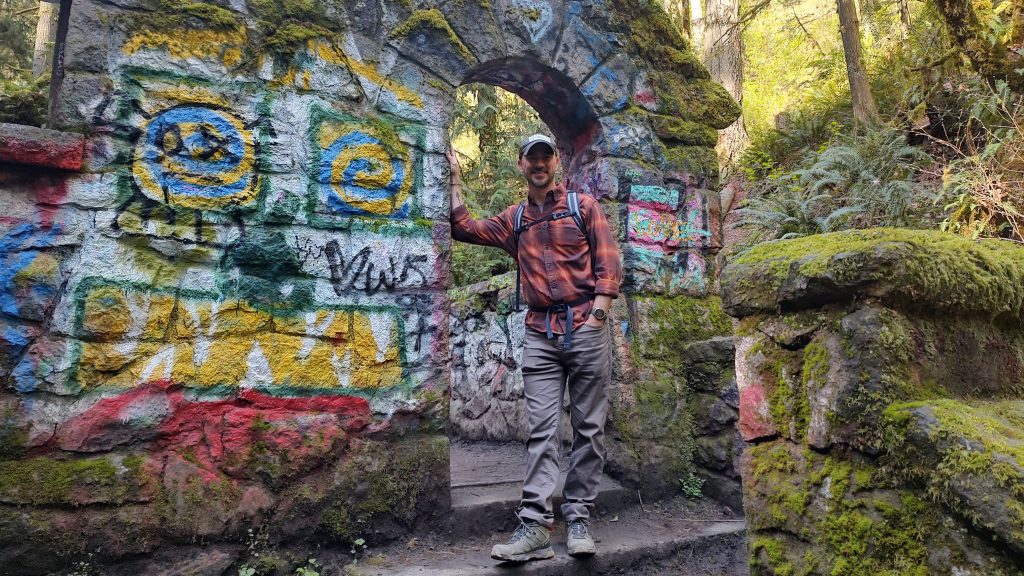
I also love how the people here have taken something mundane, like a bathroom, and over the years have made it into something spectacular through storytelling. Add to that the juxtaposition of the graffiti and the natural setting, and the Witch’s Castle seemed very Portland to me. I didn’t even tell the witches that were there that the ruins had their origin as a bathroom.
Mount Hood viewed from the ground of Pittock Mansion
“If you’re gonna visit the Witch’s Castle, you might as well go to Pittock Mansion too.” That’s what we overheard at the trailhead after returning from the Witch’s Castle. So, off we went. Supposedly it’s a couple miles from Macleay Park Trailhead, but I have to say it didn’t feel that far as we hiked it. Once there, we bypassed the ticket counter—the 1914 Pittock Mansion is probably pretty cool, but that’s not why we were there—and walked the grounds.
We circled the mansion and headed to a small overlook area with picnic tables and, as we expected, a small crowd. Luckily, everyone was pretty polite, and we didn’t have to wait long to spy Mount Hood in the distance. It’s a cool view and, unfortunately, pictures don’t really do it justice.

What’s great about this view, in addition to, “woah, that’s Mount Hood!” is that when you look out from this spot—or many spots in the city—you’re looking out across Northwest Portland, across the Willamette Valley, into the Cascades mountain range, and then onto Mount Hood, the dominant peak. We weren’t just looking at the mountain. We got to see the mountain and the city as part of the same region.
Also, yes, “woah, that’s Mount Hood!”
Why Mount Hood
Once again, Portland is an outdoors town, and Mount Hood is a visual presence that you can’t deny. We actually saw it from several places during our visit, and as the dominant peak on the landscape Hood reinforces how nature and outdoor recreation define Portland’s cultural orientation. We enjoyed viewing the mountain from the Pittock Mansion grounds alongside Portlanders and tourists, making it another shared space where locals and visitors mingle.

The mountain provides an iconic skyline that connects the Forest Park, and the city itself, to the broader geographical and cultural context of the Pacific Northwest. And, with the mansion behind us, the trail we climbed to get there, and the view of Mount Hood beyond the city, I felt a juxtaposition of the urban and the wilderness that makes Portland a cool place for people like me to visit.
The slice: Lovely’s Fifty Fifty
We did a little research before heading to the Pacific Northwest, but instead of relying on internet recommendations, we decided to ask locals when we arrived. The front desk at our hotel recommend two places: Lovely’s Fifty Fifty and Ken’s Artisan Pizza. Almost everyone we asked mentioned these two spots. There were other suggestions, but these two were recommended by everyone we asked, with the exception of one Lyft Driver who recommended Papa Murphy’s—get it together, Dennis.
Picking between pizza joints is hard, but in the end, folks told us that we could expect a wait at both places, but ice cream while we waited at Lovely’s Fifty Fifty. So, that’s where we went. Everyone was right, there was a wait. Luckily they were also correct about getting ice cream while we waited. So, dessert first.

Another advantage to Lovely’s Fifty Fifty was that the neighborhood was a delightful, walkable area that we could explore while eating ice cream and waiting for the text message letting us know that our table was ready. I enjoyed my orange agrumato ice cream, which was itself worth a visit. But the name of the series refers to pizza, so let’s get to it.
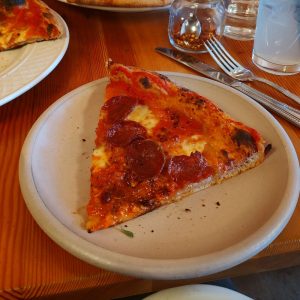
After our short walk through the neighborhood, we sat down to some good looking options. When trying new pizzas, we tend to order two; one that’s a bit unusual or new to us, and one that is something we’re pretty confident that we’ll like. At Lovely’s Fifty Fifty, our first pizza was black trumpet mushrooms with shaved onions, spinach, gremolata and etxegarai. If, like me, you don’t know what gremolata or etxegarai are, they are a green sauce and smoked sheep cheese, respectively. For our second pizza we ordered a fresh mozzarella with Sicilian oregano with salami—the closest thing to a pepperoni pizza on the menu.

Every pizza at Lovely’s is based on whole-grain sourdough crust, and any fruits and vegetables are sourced from Oregon farms. The result is pizzas that are beautiful, healthy, and absolutely delicious. Our first pizza, with the black trumpet mushrooms, had a fantastic blend of flavors that had us asking questions and Googling ingredients at the table. A pizza that tastes great and inspires curiosity is a damn good thing. And if I thought that was good, the first bite of the fresh mozzarella and salami pie punched me in the face with flavor. It was strong but balanced, with some great umami taste and a subtle but delightful tang from the sourdough crust’s long fermentation time. I fell in love with it immediately.

Why Lovely’s Fifty Fifty
Obviously, we wanted to trust the locals when it came to their food recommendations, not counting Dennis, and everyone recommended Lovely’s. The opportunity to have an ice cream appetizer helped clinch the decisions for us. But things that stand out about the restaurant are its constantly changing menu and the seasonal, locally sourced ingredients. Portland is known for a food-centric ethos where eating local extends beyond just flavor to a sense of community and environmental ethics. We wanted to eat at a pizza joint that is part of that.
If you know me or have followed me for awhile, you’ll know that while I have strong feelings about pizza, I also think a cheap pizza shared with friends is wonderful thing. Just not while I’m visiting Portland. Here, farm-to-table is the expectation not the exception, and the locality helps define the menu. It’s clear that Sarah Minnick, the chef behind Lovely’s Fifty Fifty embraces this and treats cooking as a craft, and treats pizza as equal parts delicious food and creative expression. That’s a beautiful thing.

The unique flavor combinations we found mirror the local culture of experimentation, individuality, and non-conformity. This, in turn, struck me as being tied to the city’s support of artisans and artists over chains and mass consumption. At the risk of sounding incredibly midwestern, all of that encapsulated much of what I think of when I think about Portland. Of course, I’m an outsider, but Lovely’s Fifty Fifty has been scooping cones and baking pies since 2010 and they’re still going strong—so, they must be doing something right.
Thank you, Portland
 As a city so connected to outdoor recreation, weirdness, and meaningful food, Portland provided the perfect place to kick off Hike, Sight, and Slice. We only stayed a few days and only saw a fraction of what the city has to offer, but the city made it’s point quickly. This is a place where the outdoors, creativity, and the local community seem to overlap in all aspects of life. You don’t have to look very hard to see that. Get outside, find something interesting, support someone local, and don’t worry too much about whether it all makes sense.
In this case it took the form of a trail that feels like wilderness in the middle of town, a crumbling bathroom turned folklore landmark, a mountain that watches over everything, and a pizza with flavors reflecting the region it’s made in. That’s enough to get a taste of a place’s culture, and if this series is about connecting with the spirit of a place, Portland set a high bar.